


What is EXModel?
-

Why User Use EXModel for Reverse Rngineering
Get a Free DemoOptimized natively for Shining 3D workflows, EXModel is an intuitive, cost effective reverse engineering software. It features real time accuracy checks and robust extraction tools, letting designers quickly convert raw scans into precise CAD models without a steep learning curve.
-

Reverse Engineering with EXModel
Request a Free TrialEXModel streamlines the transition from raw scans to production ready CAD. Using its scan preparation wizard and parametric extraction tools, you can easily clean meshes, rebuild solid elements, and export standard IGES or STEP files directly to manufacturing.


Typical Workflow Using EXModel

See How Businesses Use This in the Real World
-

Industrial & Manufacturing
Machinery shops utilize primitive feature extraction and coordinate alignment to turn raw scan data into production-ready CAD components.
-

Product Design & Creative
Industrial designers apply freeform modeling and auto surfacing tools to convert handcrafted mockups into editable digital concepts.
-

Automotive & Aerospace
Engineers clean up complex aftermarket components with the scan data preparation wizard and rebuild geometric engine components accurately.
-

Healthcare & Medical
Orthotics technicians smoothly process large mesh data of the human body, removing scan noise and refining shapes for custom ergonomic solutions.


See EXModel in Real Design Workflows

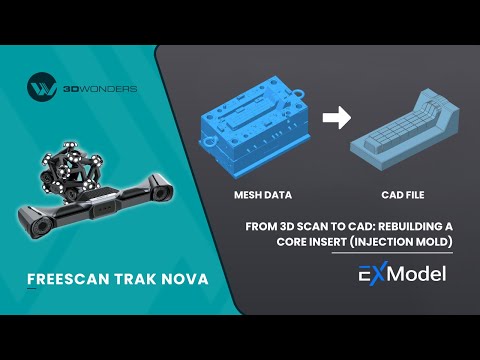
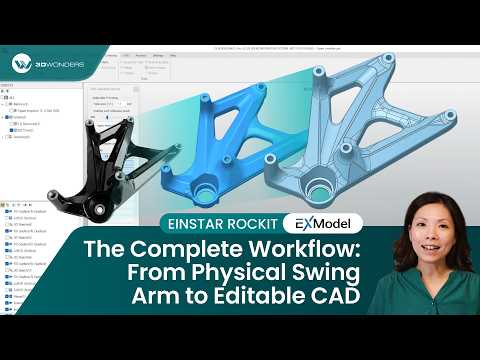

As an authorized Gold Reseller of Shining 3D. 3D Wonders provides licensed software, expert onboarding, and dedicated customer support—ensuring you get the most from every update.
Computer Requirements
| Category | Requirements |
|---|---|
| Operating System | Windows 10 (64-bit) or Windows 11 |
| Processor (CPU) | Intel i5 or higher (or its equivalent of another CPU manufacturer) |
| Memory (RAM) | 16 GB |
| Graphics (GPU) | Dedicated graphics card – nVidia or AMD |
| Storage | 256 GB |
Function Features Comparison
Start Using EXModel
Frequently Asked Questions
Looking for something specific? Let us know, and we’ll be happy to assist you.
EXModel is built as the native reverse engineering software for Shining 3D products, ensuring seamless workflow compatibility and high-performance data processing.
Yes. It features a comprehensive scan data preparation wizard to handle mesh segmentation, fill holes, and smooth data before modeling extraction.
Yes, it includes built-in 2D and 3D primitive geometry extraction to effortlessly generate accurate planes, cylinders, spheres, and cross-sections.
Both versions allow you to export your completed geometry features and profiles as standard IGES, STEP, and DXF files.
Yes, it includes a real-time deviation control function that displays a live color map to ensure your CAD model matches the original scan data.
No, advanced hybrid modeling of solids and freeform surfaces is a powerful feature exclusive to the EXModel Pro tier.
Yes, transferring your complete feature design tree directly into external CAD packages is fully supported using the EXModel Pro edition.
The platform is engineered for large mesh data processing, optimizing resource utilization to allow smooth scaling and extraction on dense geometry.
Absolutely. Automatic surfacing and manual freeform modeling tools are fully supported across both software versions.
The standard version supports baseline sketching, but advanced constraints, offsets, and patterns within 2D sketches require EXModel Pro.


