

The FreeScan Combo Wireless Series is SHINING 3D's wireless handheld metrology 3D scanner lineup, and it marks a complete transition away from the tethered FreeScan Combo series it's built on. The series includes two models, FreeScan Combo Wireless and FreeScan Combo+ Wireless, both cutting the cord entirely with Wi-Fi 7 while holding 0.02 mm accuracy.
The Combo+ Wireless is the higher-throughput model, scanning at up to 9,106,000 points per second with 93 laser lines, while FreeScan Combo Wireless scans at up to 7,344,000 points per second with 50 laser lines.
At a glance
The series
What is the FreeScan Combo Wireless Series?
The FreeScan Combo Wireless Series is SHINING 3D's wireless handheld metrology 3D scanner lineup, built for inspection, quality control, and reverse engineering work. It pairs SHINING 3D's hybrid light source technology (blue laser plus VCSEL infrared) with Wi-Fi 7 connectivity, so operators can capture parts without keeping a physical cable between the scanner and the computer.
If you've used a FreeScan Combo before, you already know the compact body and hybrid light source that made the Combo series useful in the first place. Both models in the FreeScan Combo Wireless Series keep that design and change the connection to your workstation: this is a complete transition to wireless operation, not a tethered scanner with a wireless mode bolted on.
Two models in the FreeScan Combo Wireless Series
Both share the same accuracy, scan modes, dimensions, and weight. The comparison section below breaks down exactly where they diverge.
FreeScan Combo Wireless
FreeScan Combo+ Wireless
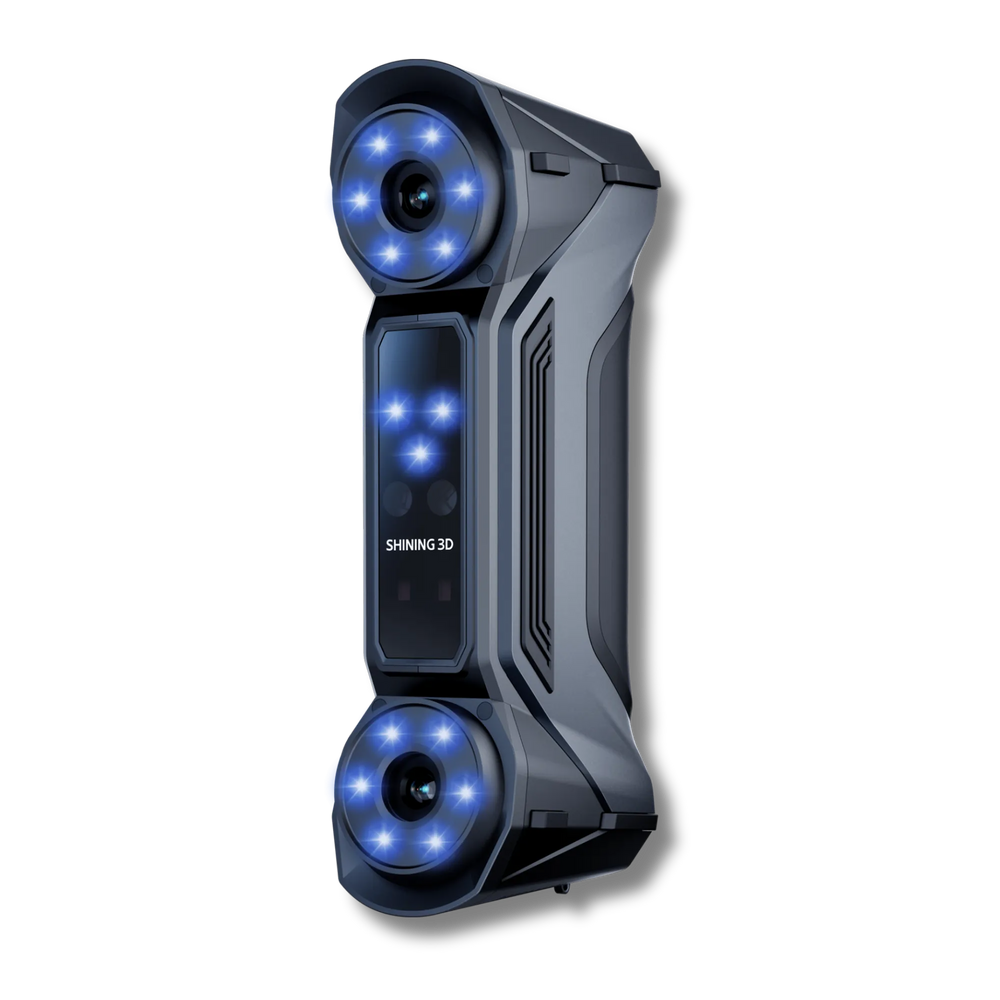
Wireless handheld metrology
FreeScan Combo Wireless Series
Starting at $13,999.00
SHINING 3D's hybrid blue laser + VCSEL infrared handheld scanner, now fully wireless over Wi-Fi 7.
Built compact, built for long shifts
Both models measure 189 × 81 × 53 mm and weigh 550 g. Each connects over Wi-Fi 7 or USB 3.0, whichever your workflow calls for on a given day.
Why wireless
Why wireless changes the handheld 3D scanning workflow
Here's the problem every handheld metrology team knows: a cable is fine right up until you need to walk around a large casting, climb into a vehicle interior, or work a job site where a laptop tether just isn't practical.
The cord decides how far you can move. Not the part. Not you.
Move freely around large or awkward objects
Large castings, automotive bodies, machinery, molds, transportation components. These are all objects you can't easily spin around on a bench. With either model, the operator moves around the part instead of managing a cable at the same time. In practice, it's the difference between a smooth scan pass and constant stopping to reposition a cord.
Reach confined and complex spaces more easily
At 550 g, both scanners are light enough to work into vehicle footwells, interior panels, and tight machinery access points without wearing out your arm halfway through the job. The lightweight, compact design keeps scanning agile from start to finish, and that matters most in the spaces a wired scanner struggles to reach at all.
Fewer interruptions on long scanning jobs
The high-capacity battery supports up to two hours of continuous scanning, and it pairs with a rapid-charging dock, on both models. When one battery runs low, you swap it and keep working instead of waiting out a charge cycle mid-job.
Model comparison
FreeScan Combo+ Wireless vs FreeScan Combo Wireless
Both models run on the same wireless platform, with identical accuracy, scan modes, size, and weight. The difference comes down to throughput: FreeScan Combo+ Wireless scans with 93 high-speed laser lines at up to 9,106,000 points per second, while FreeScan Combo Wireless uses 50 laser lines at up to 7,344,000 points per second. Highlighted rows are the specs that differ.
The real difference: throughput, not accuracy
FreeScan Combo+ Wireless is the model to reach for when scanning throughput matters most, on large components, high part volumes, or time-boxed inspection windows. It's not more accurate than FreeScan Combo Wireless. Both hold the same 0.02 mm accuracy and 0.02 mm + 0.015 mm/m volumetric accuracy with VPG.
What the Combo+ buys you is more laser lines per pass, and that translates directly into faster capture. FreeScan Combo Wireless, meanwhile, gives you the same wireless platform and metrology-grade accuracy at a lower throughput tier, which is plenty for teams that don't need the added acquisition speed.
Connectivity
How Wi-Fi 7 enables greater scanning mobility
Both models in the FreeScan Combo Wireless Series use Wi-Fi 7 to transmit scan data between the scanner and your computer, which is what lets operators move around a component without a physical data cable holding them back.
Cable-free data transmission
The workflow looks like this, with no cable in the chain:
Designed for industrial environments, not just the lab
SHINING 3D built the FreeScan Combo Wireless Series for actual shop floors, not clean rooms. Each scanner pairs the Wi-Fi 7 protocol with advanced anti-interference technology, delivering stable data transmission across complex factory floors and challenging outdoor environments, the kind of wireless-dense space where interference typically causes problems for handheld devices.
Wireless when you want it, wired when you need it
USB 3.0 is still listed as a supported connection standard on both models, so if a specific job calls for a hardwired connection, that option hasn't gone anywhere.
Accuracy
How the FreeScan Combo Wireless Series maintains metrology-grade accuracy
Going wireless is only worth it if the numbers hold up. Both models in the series specify 0.02 mm accuracy, with volumetric accuracy up to 0.02 mm + 0.015 mm/m when using Video Photogrammetry.
Certified and traceable accuracy. Every system is calibrated by the SHINING 3D Accuracy Laboratory, which is accredited by CNAS in accordance with ISO 17025. Calibration procedures in that lab follow ISO 10360 standards, the international benchmark for acceptance and reverification testing of coordinate measuring systems. That's not a marketing claim, it's a documented, third-party-accredited process behind every unit that ships.
What Video Photogrammetry actually does
VPG is SHINING 3D's patented photogrammetry technology, built into both models, and it continuously optimizes the spatial position of reference markers throughout the scanning process.
Why that matters on large parts
Small positioning errors compound the farther you move across a surface. VPG exists to minimize that cumulative drift, keeping measurements consistent across large-scale components. Think castings, vehicle bodies, industrial assemblies, anything where the scan path covers real distance. This is the mode you reach for when the part is too big to trust to a single reference frame.
Video Photogrammetry helps maintain global measurement accuracy during large-part scanning by continuously optimizing reference-marker positions throughout the capture process.
Scan modes
Five scan modes for different parts and inspection tasks
One scanner, five ways to capture data, on both models in the series. That's the real advantage of the hybrid platform: you're not swapping scanners when the geometry changes, you're switching modes.
High-speed scan
93 laser lines on the Combo+ Wireless, 50 on FreeScan Combo Wireless, both running at 180 frames per second for smooth, stable tracking even during fast operator movement. This is the mode for covering large surface areas quickly.
Detailed scan
25 parallel laser lines on both models, built for finer mechanical detail where you need closer surface capture than the high-speed mode provides.
Deep-pockets scan
A single laser line on both models, purpose-built for deep holes, narrow slots, and recessed geometry that a wide beam simply can't reach into cleanly.
IR rapid scan
Positioned for quick scans, using the infrared VCSEL light source rather than the laser, on both models.
VPG scan
Built for large components and longer scanning distances, where you need consistent global measurement across the whole part rather than just local accuracy, on both models.
Speed
How faster data capture improves inspection efficiency
It's easy to treat "93 laser lines" as a number on a spec sheet. What it actually means is a shorter path from part to result, and it's the clearest way to see what separates the two models in the series. That's the chain, and every link matters:
93 laser lines on FreeScan Combo+ Wireless
More coverage per pass reduces the number of scan paths needed to fully capture a surface, which is where most of the time savings actually come from. FreeScan Combo Wireless covers the same ground with 50 laser lines, still fast, just a step down in raw throughput.
180 frames per second
This is what keeps tracking smooth and stable even when you're moving the scanner quickly across a part, on both models. Without it, fast movement means dropped tracking and rescans.
Up to 9,106,000 points per second
The practical result, on FreeScan Combo+ Wireless: complex surfaces, deep holes, narrow slots, and large-scale components can all be scanned efficiently in one session. FreeScan Combo Wireless tops out at 7,344,000 points/s, still well ahead of a wired predecessor.
Real-time mesh generation
Meshes generate in real time during the scan, not after, on both models, which shortens the path from capture to analysis and means you're not waiting on a separate meshing step before you can look at your data.
Scan quality
How FreeScan software helps validate scan quality during capture
Quality starts at capture, not after you've already left the part behind. This applies across the FreeScan Combo Wireless Series.
Real-time display of mesh data
The software displays mesh data as you scan, so you can see coverage building in real time instead of finding gaps after the fact.
AI feature recognition
Intelligent boundary detection handles fast, precise measurement of round holes, rectangular holes, and slots, which keeps data capture both high-quality and high-accuracy on parts with a lot of machined features.
Intelligent resolution
Mesh resolution adjusts automatically based on the object's curvature, so tighter curves get more detail without you having to manually adjust settings mid-scan.
Data quality visualization
Judge whether your scanning distance is right by watching the rendering color of the projected laser lines in the software's 3D view, or by the scanner's own LED indicator. A real-time mesh quality indicator shows which areas are sufficient and which need another pass, while the part is still in front of the operator.
Scan to inspection
From 3D scanning to inspection with SHINING3D Inspect
Capturing a clean scan is only half the job. Both models connect directly into SHINING3D Inspect, so the path from scan to inspection result doesn't run through a separate application.
Dimensional analysis
Compare scanned geometry against reference data or inspection requirements directly inside the connected workflow.
GD&T evaluation
Geometric Dimensioning and Tolerancing evaluation is built into the inspection toolset, not bolted on as a separate step.
Color-map comparison
Deviation maps visualize where a part diverges from its reference model, at a glance, in color.
Inspection reporting
Move from captured geometry to a documented result without re-entering data into a different tool.

Inspection software
SHINING3D Inspect
Certified by PTB and supporting a wide range of quality control and inspection applications across manufacturing industries. Both models in the FreeScan Combo Wireless Series connect directly into it.
View SHINING3D Inspect →Industries
Where the FreeScan Combo Wireless Series fits: industries and applications
Automotive
The brochure documents the scanner in use on automotive seats, tires, interior floor mats, and body panels, alongside a full vehicle body scan using VPG. That range, from a seat's stitching to a car's overall body geometry, is what makes the scan mode selection matter: detailed mode for the interior work, VPG for the full-body pass, without switching scanners in between.
Heavy industry
Large castings, machinery, and industrial components benefit from the same wireless mobility that helps automotive teams: walk around the part, not around a cable.
Transportation
Large transportation components need geometry verification and maintenance-related measurement, often in the field rather than a controlled lab. That's exactly the environment Wi-Fi 7 and the anti-interference design were built for.
Energy
Field scanning of large, complex industrial equipment is a natural fit for a lightweight, wireless platform that doesn't require a controlled setup to run.
General manufacturing and quality control
Dimensional verification, first-article inspection, tooling inspection, part-to-CAD comparison, and reverse engineering all sit within the workflow the series and SHINING3D Inspect are built to support.
SHINING 3D positions the FreeScan Combo Wireless Series across automotive, heavy industry, transportation, energy, and other demanding sectors, and the shared thread across all of them is the same: teams that need to move around large or complex parts without losing metrology-grade accuracy.
Buying decision
Which FreeScan Combo Wireless model should you choose?
Both models belong to the FreeScan Combo Wireless Series, so the choice comes down to throughput needs, not accuracy or build quality.
FreeScan Combo+ Wireless
FreeScan Combo Wireless
What both models share
Ready to go wireless?
Built to keep up with where the work actually happens
We've spent enough time around handheld scanners to know when a cable stops being a minor annoyance and starts being the actual limit on what you can inspect. The FreeScan Combo Wireless Series is built around removing that limit, on both models. Wi-Fi 7 handles the connection, the laser lines and VPG handle the data, and SHINING3D Inspect handles what happens after the scan is done.
Whether you're covering a large casting on a factory floor or working detail into a tight interior panel, this is a lineup built to keep up with where the work actually happens.
Buy or talk it through
Bring wireless mobility into your inspection workflow
Buy FreeScan Combo Wireless or FreeScan Combo+ Wireless directly through 3D Wonders, or talk through which model fits your parts first. Our team is glad to walk through it with you.
FAQ