

You can 3D scan a Corvette outdoors, but direct midday sunlight can make the job dramatically harder than expected. We put a brand-new 2026 Corvette Stingray in front of the EinScan Trak, first under full midday sun, then again in shade, using the same car, the same paint, and the same scanner both times.
At a glance
The experiment
Introduction: the experiment
Patricia, our CEO at 3D Wonders, showed up to this shoot with a suitcase. Inside was the EinScan Trak, and the plan was to point it at a brand-new 2026 Corvette Stingray sitting in full midday sun.
Can you take a professional 3D scanner outside and capture the whole car without plastering every panel in markers?
That's the exact question we, the team at 3D Wonders, set out to answer. The conditions were about as unforgiving as outdoor scanning gets.
2026 Corvette Stingray
Straight off the lot, with the kind of glossy factory paint that throws reflections everywhere.
EinScan Trak
A tracked 3D scanning system that pairs a handheld scanner with a positioning tracker for capturing larger objects.
Strong direct sun
A large vehicle and a paint job with almost no matte surface to hide behind.
How we set up the test
No new scanner, no different vehicle. Just a change of environment.
Scan in direct sunlight
Scan the Corvette under strong midday sun and see what happens.
Move into shade if needed
If that proves too tough, move the same car into shade and check whether lighting alone changes the outcome.
The short answer
Can you really 3D scan a Corvette in direct sunlight?
Yes, 3D scanning can be done outdoors, but intense direct sunlight can make optical scanning significantly more challenging. In our test, the first attempt under strong midday sun was hard going. When we moved the same car into shade, the scan came together with far less effort.
What made this particular test so demanding was a combination of four factors stacked on top of each other. Any one of those on its own is manageable. All four at once is a genuine stress test.
The challenge
Why a brand-new Corvette is such a difficult 3D scanning test
Large, continuous body panels
Scanning an entire vehicle is a different job than scanning a small part. A hood, a set of doors, the quarter panels, the front and rear sections. Each needs its own scanner position, and the system has to keep track of how they all fit together as one continuous surface.
Highly reflective new paint
A fresh factory clear coat produces bright highlights and hard reflections. That's part of what makes new cars look so good in a showroom, and part of what makes them tough to scan.
Smooth vehicle geometry
Large smooth surfaces can actually be more demanding for a 3D scanner than objects with lots of distinct geometric features, since there's less surface detail for the system to lock onto.
Exterior and interior requirements
A full vehicle scan doesn't stop at the body. It also means capturing tight, detailed interior spaces like a dashboard, which is a completely different scanning problem than a wide-open hood.
We picked the EinScan Trak for this job because the system supports tracked scanning for larger objects like a car body, and the scanner itself detaches for handheld use when the job gets small and tight, like an interior.
Test 1 · Direct midday sun
Our first attempt: scanning the Corvette in midday sun
The first setup: an outdoor location, strong midday sun overhead, a brand-new Corvette, the EinScan Trak tracker and scanner, and a clear goal of avoiding markers across the entire car.
We'll be candid about how it went. The first test was difficult. The scanner had trouble acquiring the Corvette consistently under those conditions.
The intense midday sunlight
The extremely reflective new paint
We couldn't tell right away whether the main problem was the sun, the paint, or both working together.
That uncertainty is exactly what pushed us into a second test.
The physics
Why direct sunlight can make 3D scanning difficult
Optical 3D scanning depends on light. The scanner projects light onto a surface, and cameras read the information that light reveals about the object's shape. That's the basic mechanism behind the whole process.
Strong ambient light adds another variable to that equation. In harsh outdoor conditions, sunlight can overwhelm the scanner's own projected light, effectively drowning out the exact signal the cameras are trying to read.
Think of it like a light source that's obvious indoors getting washed out entirely once it's up against the full brightness of a clear midday sky.
To be precise: this doesn't mean the EinScan Trak can't handle sunlight in general. What our test showed is that the extreme sunlight conditions we encountered made this particular automotive scan substantially more difficult.
The surface
Does reflective car paint make the problem worse?
Glossy surfaces are challenging for optical scanning because of:
New paint raises the difficulty further. The Corvette had fresh, highly reflective paint rather than a matte or weathered finish, which meant more of those reflection issues showed up across more of the car.
We weren't testing sunlight in isolation. We were testing strong sunlight hitting one of the most reflective surfaces you're likely to encounter in automotive scanning work.
Can you 3D scan shiny automotive paint? Yes, but highly reflective paint can make scanning more demanding. Lighting, surface angle, scanner settings, and the specific scanning system in use can all affect the result.
Test 2 · Outdoor shade
Our second attempt: moving the Corvette into the shade
Instead of swapping the scanner or modifying the car, we changed one major environmental variable: direct sunlight. We moved to a second location in an industrial district in San Francisco and found a shaded spot that looked promising for a second attempt.
The scan became much easier. Same Corvette, same reflective paint, same scanner, far less direct sunlight, and a very different result.
Because the car and the scanner stayed identical between both tests, this points to lighting conditions as a major contributor to the difficulty we ran into during the first attempt. We're not calling this a controlled scientific experiment that isolates sunlight as the sole cause. It's a real-world field test, and the difference between the two attempts was clear enough to matter.
Side by side
Sun vs. shade: what changed?
In our real-world Corvette test, moving into shade had a major impact on scanning performance.
A note on scope. This was a single field test on one vehicle in two locations, not a controlled lab study. It doesn't isolate sunlight as the only variable at play, and results can vary with a different car, paint finish, time of day, or scanner setup. Treat it as a real-world data point rather than a universal rule.
Markers
How we scanned the Corvette without covering it in markers
We didn't scan the entire car completely marker-free. What we avoided was covering every body panel in markers. That's the actual advantage worth explaining.
Minimal-marker automotive scanning
When the tracker needed to move to a new position to reach another part of the car, shared markers between neighboring scan areas helped establish alignment between those sections.
Completely marker-free automotive scanning
The more accurate description of this workflow is minimal-marker, not completely marker-free.
SHINING 3D describes Trak Mode as capable of capturing point-cloud data without markers during a single-station scan, while global markers are available for workflows that need alignment between multiple positions.
Workflow
How we moved the tracker around the Corvette
Finish the first scan area
Capture the portion of the vehicle visible from the initial tracker position.
Move the tracker
Relocate it so a new section of the vehicle comes into view.
Capture the shared markers
Scan the markers that provide reference information linking the previous position to the new one.
Establish alignment
Use those shared references to keep the two sections lined up as one continuous surface.
Continue scanning
Resume capturing the Corvette from the new tracker position.
Interior
Scanning the Corvette interior
Large exterior panels suit tracked scanning well. A dashboard is a different problem entirely: tight access, smaller details, and confined viewing angles that a tracker mounted at a distance isn't built for.
For the interior, we detached the scanner from the modular tracking system and used it independently as a handheld unit. SHINING 3D describes the EinScan Trak as a modular system with detachable handheld components, supporting both tracked and standalone scanner modes.
Large exterior surfaces
Hood, doors, quarter panels, front and rear sections.
Interiors and confined areas
Dashboard and other tight, detailed spaces.
The equipment
EinScan Trak: technical overview
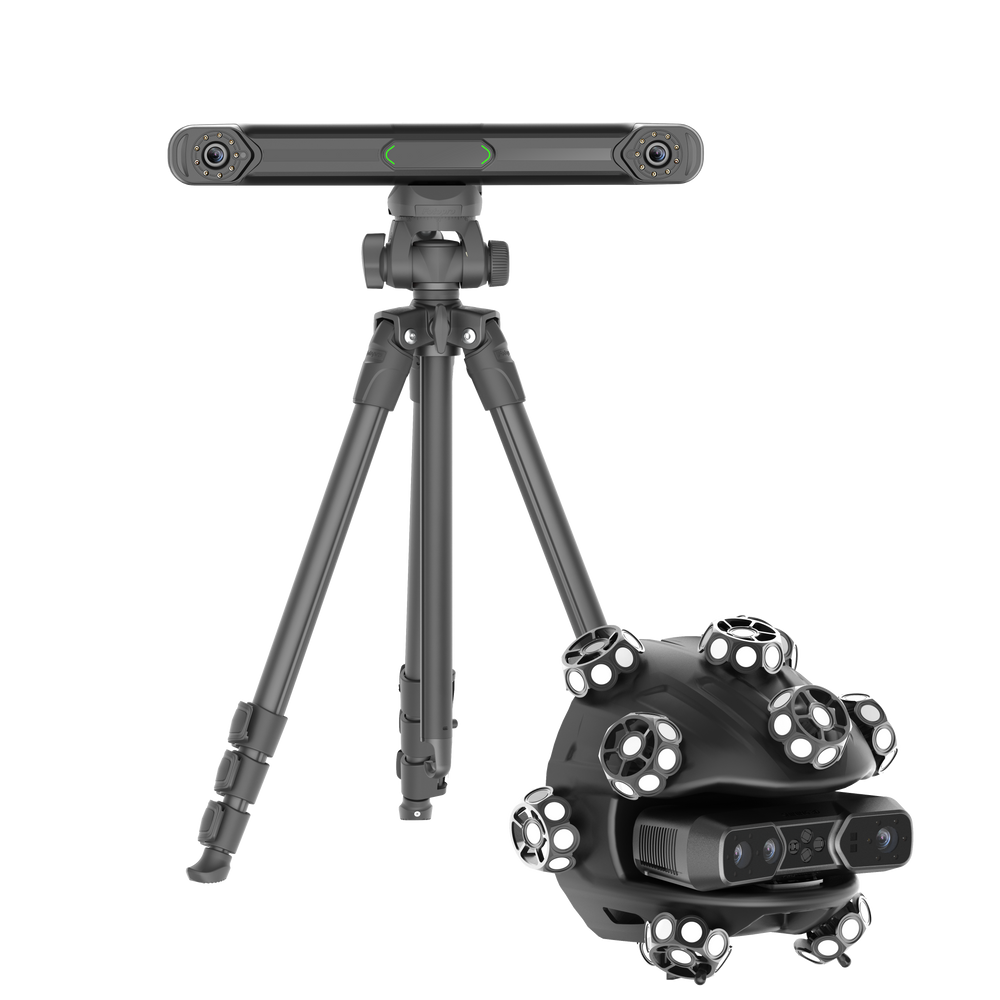
Used in this test
EinScan Trak
$6,999.00
A modular 3D scanning system made by SHINING 3D, built around a tracker unit and a detachable handheld scanner.
The scorecard
The final result: did the EinScan Trak pass the test?
Can you scan a Corvette in the sun? Yes, but intense midday sunlight can make the job significantly more difficult.
Once we moved the same reflective Corvette into shade, scanning became much easier.
Lessons learned
What we learned about 3D scanning cars outdoors
Applications
Where automotive 3D scanning can be used
Reverse engineering
Converting physical vehicle geometry into usable digital data for downstream design work.
Aftermarket component design
Body kits, splitters, spoilers, diffusers, bumpers, fenders, and other custom accessories that need to match an exact vehicle shape.
Vehicle customization
Capturing existing geometry as the starting point for parts that have to fit precisely.
Inspection and quality workflows
Using scan data as part of dimensional comparison processes where that level of verification is needed.
Restoration
Digitizing rare or hard-to-source components for reproduction.
Digital archiving
Preserving vehicle geometry for future reference or documentation.
If you're not sure which scanning setup fits your automotive application, our team can walk through it with you before you commit to any equipment.
The verdict
So, can you scan a Corvette in the sun?
Yes, but our experiment showed the sun can make a real difference. The brand-new Corvette was tough to capture under intense midday sunlight, especially with its highly reflective paint. Moving that same vehicle into shade made the entire process much easier.
The takeaway isn't just that the EinScan Trak could scan a Corvette. It's that environmental conditions deserve real planning when you're setting up a real-world automotive 3D scanning project.

Want to see more real-world tests like this one? Follow along on our YouTube channel for more videos on how the tracker system handles different jobs.
FAQ