

FreeScan Trak Nova and FreeScan Trak Nova+ share the same wireless tracking and scanning architecture and the same accuracy. The difference between them is throughput and working range, so the right one depends on what your jobs actually need.
Nova → Nova+: here's what's different
Nova covers a wide range of parts comfortably at its own pace. Nova+ covers the same ground faster and with a wider working range, which matters most once acquisition time or coverage becomes the limiting factor rather than accuracy.
At a glance
The system
What is FreeScan Trak Nova+?
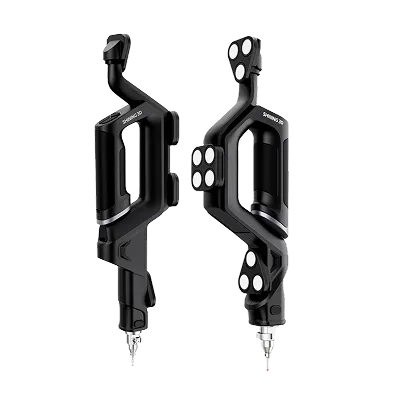
FreeScan Trak Nova+ is part of SHINING 3D's FreeScan Trak Nova Series, a wireless, multi-functional dynamic tracking and scanning system built for large-scale industrial 3D measurement. The system combines three capabilities in one workflow: a portable tracking scanner, a wide field-of-view handheld laser scanner, and a video photogrammetry (VPG) module.
The Nova Series architecture runs on two hardware components:
TE Nova+
The scanner used for real-time dynamic tracking
UE Nova+
The tracking unit that doubles as a wide-range handheld laser scanner
Both components ship wireless, with a wired fiber-optic mode available when a job calls for it. Neither requires markers placed on the part during tracking, since dynamic tracking handles that in real time.

Nova and Nova+ configurations
FreeScan Trak Nova Series
SHINING 3D's wireless, multi-functional dynamic tracking and scanning system, available as Nova or Nova+.
Where Nova+ fits in the product line
Think of Nova+ as the same measurement architecture as Nova, tuned for faster data acquisition.
It's not a new category of scanner, and SHINING 3D doesn't position it that way. The two systems share the same certifications, the same output formats, the same operating temperature range, and the same core accuracy class. What Nova+ changes is how much data you can pull off a part in a given amount of time, and how large a volume the UE tracker can cover without repositioning.
Head to head
FreeScan Trak Nova+ vs FreeScan Trak Nova: the direct comparison
This is the table that matters most if you're deciding between the two systems. Highlighted rows are the specs that changed.
The one-sentence version
The difference between FreeScan Trak Nova+ and FreeScan Trak Nova comes down to throughput and coverage, not precision. Nova+ scans faster, resolves more detail per pass, and lets the UE tracker cover a wider working range, while both systems hold the same listed 0.02 mm accuracy and the same volumetric accuracy figures.
What's new
What actually changed in FreeScan Trak Nova+
Scan speed increases to 7,600,000 points per second
FreeScan Trak Nova scans at up to 6,140,000 points per second. FreeScan Trak Nova+ raises that ceiling to 7,600,000 points per second, a jump of roughly 24%. In practical terms, that means more surface data captured per pass across a large component, which shortens total scan time on big parts without asking the operator to change technique.
62 laser lines for high-speed scanning
Nova runs high-speed scanning on 50 laser lines. Nova+ runs it on 62. More simultaneous laser lines means faster coverage of broad, relatively simple surfaces, the kind you find on panels, molds, and structural components.
25 parallel laser lines for detailed scanning
This is the number worth sitting with. Nova's detailed scan mode uses 7 parallel laser lines. Nova+ uses 25. That's more than triple the line count, and it's the largest single change on the entire spec sheet. If your work involves fine features, edges, or complex geometry that needs the detailed scan mode rather than the high-speed mode, this is where Nova+ earns its name.
Expanded FreeScan UE Nova+ flexible field of view
FreeScan UE Nova has a flexible field of view of 2700 mm, ranging from 800 to 3500 mm. FreeScan UE Nova+ expands that to 4000 mm, ranging from 500 to 4500 mm. That's a wider working envelope on both ends, closer for tight setups and further out for large, open components. Fewer repositions, fewer stitched passes, less setup overhead per part.
What these four changes add up to: faster point acquisition, more laser lines in both scan modes, and a wider UE working range point at one problem: teams spending too much time acquiring data on large or geometrically complex parts. The net effect lands entirely on speed: how quickly you can pull a given amount of measurable data off a part.
What didn't change
What stayed the same, and why that's worth knowing
An honest comparison has to include the specs that didn't move, because they tell you whether an upgrade actually changes your outcomes.
Accuracy holds at 0.02 mm
Both FreeScan Trak Nova and FreeScan Trak Nova+ list 0.02 mm accuracy. If your current Nova is already meeting your tolerance requirements, Nova+ won't improve on that number. It's the same accuracy class, verified the same way.
Volumetric accuracy is identical
Both systems list 0.062 mm at 12 m³ for standard volumetric accuracy, and 0.046 mm plus 0.012 mm/m for VPG-assisted volumetric accuracy on extension volumes. No change between generations.
Deep-pocket scanning is unchanged
Both systems use a single laser line for deep-pocket scanning, unaffected by the throughput increases in the other two scan modes.
Certification and acceptance testing are identical
Both generations are acceptance tested according to VDI/VDE 2634 Part 3 and ISO 10360, verified inside an ISO/IEC 17025 accredited accuracy laboratory. Both hold the same certification set: CE, FCC, ROHS, WEEE, KC, FDA, UKCA, IP50, TELEC, and TiSAX.
Based on the specification sheet, Nova+ is a productivity upgrade layered on top of an unchanged accuracy foundation.
That's a deliberate engineering choice, and it tells you exactly who should care about upgrading.
How it works
How the FreeScan Trak Nova+ system actually works
Dynamic tracking removes markers from the workflow
Real-time dynamic tracking lets the TE Nova+ scanner follow the part without coded markers stuck to the surface. That cuts setup time and removes a prep step that, on a large or awkward part, can eat up a meaningful chunk of the job.
FreeScan UE Nova+ doubles as a wide-range handheld scanner
UE Nova+ isn't just the tracking half of the pair. It also functions as a standalone handheld laser scanner with a wide field of view, the same role filled by the FreeScan UE Nova when sold on its own, which means the same hardware covers both the tracking role and the broad-surface scanning role without swapping tools mid-job.
Video photogrammetry handles the big stuff
For genuinely large objects, the Nova Series uses SHINING 3D's video-based photogrammetry (VPG) workflow. A calibration rod paired with real-time marker verification through video capture keeps volumetric accuracy consistent across a part that's too large for a single tracking setup to handle cleanly, all without coded markers.
Multi-scan mode data fusion ties it together
The system merges wide-range laser scanning, which captures overall geometry, with dynamic tracking, which captures fine local features, into a single unified dataset. That's the practical benefit of having both scan modes live on the same platform: you're not reconciling two separate files from two separate tools.
Use cases
Where the FreeScan Trak Nova+ improvements actually matter
Not every job benefits equally from a throughput increase. Here's where the Nova+ changes translate into real time savings.
Large industrial components
Heavy equipment, marine molds, exterior panels
Higher scan speed and 62 laser lines cover broad surfaces faster
Detailed features inside larger assemblies
25 parallel laser lines resolve fine detail without switching systems
Confined or hard-to-reach areas
TE Nova+ stays at 1.2 kg, so maneuverability doesn't trade off against speed
Large measurement volumes
Expanded UE Nova+ FOV (4000 mm, 500 to 4500 mm) means fewer repositions
Long or mobile inspection days
Swappable batteries and wireless operation keep throughput gains from being undercut by downtime
If your work sits mostly in small parts, tight tolerances, and deep pockets, where accuracy is the bottleneck rather than acquisition time, the case for upgrading is weaker. That's a legitimate answer, and we'd rather tell you that up front than sell past it.
Specifications
FreeScan Trak Nova+ full specifications
FreeScan Trak Nova+ is a two-component system. The tables below list TE Nova+ (the tracking scanner) and UE Nova+ (the wide-range tracker that also functions as a standalone handheld scanner) separately, since their specifications differ.
Measurement performance
Working envelope
Shared system specifications
FreeProbe Series (optional add-on)
Applications
FreeScan Trak Nova+ applications
The Nova Series architecture is built around large, complex, or hard-to-access parts. Documented application areas include:
The common thread across these applications isn't the industry. It's part size and geometric complexity.
Part size and geometric complexity large enough that a fixed-arm CMM or a small handheld scanner becomes impractical, and portable enough that the job still needs to move to the part rather than the part moving to a lab.
Real deployments in a few of these areas, including heavy equipment refurbishment and full-scale aircraft digitization, are documented in 3D Wonders' case studies. If you're still narrowing down whether a tracked system like Nova+ is the right category for your part size at all, the 3D Scanner Shopping Guide walks through that decision before you get to the Nova-specific details.
Ecosystem
FreeScan Trak Nova+ ecosystem and accessories

Optional software
SHINING3D Inspect
An inspection software layer built to run on top of Nova+ scan data, covering:
Optional accessory
FreeProbe Series
A wireless, dynamically tracked probing accessory for point-based measurements that a laser scan alone doesn't cover cleanly, like precise hole centers or datum points.
Mobile Workstation
An all-in-one mobile scanning station with a built-in computer and power supply, designed to bring the workstation to the part instead of the other way around. Compatible with the full FreeScan Trak Nova Series.
Works with your inspection stack
Nova+ scan data also flows into the wider metrology inspection stack 3D Wonders carries, including PolyWorks Inspector, Verisurf Inspection Software, and Geomagic Control X. Which one fits depends on your existing GD&T workflow and reporting standards, not on the scanner itself.
Before you request a quote
What to consider before requesting a FreeScan Trak Nova+ quote
If the throughput numbers above line up with a bottleneck you're actually running into, the next step is a configuration conversation, not a spec sheet. A faster, more useful quote conversation starts with a few specifics decided ahead of time:
These seven data points determine configuration more than any single spec on the sheet above. Two shops running identical FreeScan Trak Nova+ hardware can end up with very different bundles once part size, environment, and add-ons are factored in.
Work with 3D Wonders
Get a configuration consultation from 3D Wonders
3D Wonders works directly with buyers on FreeScan Trak Nova+ configuration, pricing, and demonstrations. That includes:
Explore more of the Nova Series ecosystem
The bottom line
Nova or Nova+?
Nova and Nova+ share the same foundation: 0.02 mm accuracy, 0.062 mm volumetric accuracy over 12 m³, VPG, and a flexible FOV up to 2600 × 2200 mm. Both are built for large-scale measurement. Nova+ adds speed, detail, and tracking reach, so the decision comes down to how hard your large-part work pushes those three:
Stay on Nova
if its scan speed and 7-line detailed mode already get your jobs done on schedule, and your parts fit within the 800 to 3,500 mm tracking range without frequent tracker repositioning.
Move to Nova+
if you're scanning large or complex parts where throughput matters (up to 7,600,000 points/s), spend real time capturing fine features (25 parallel lines in detailed scan versus 7), or keep repositioning the UE tracker on big components (tracking depth extended to 500 to 4,500 mm).
Neither may be the right fit
if your work is mostly small, bench-sized parts, where a tracked system's large measurement volume goes unused and a standalone handheld scanner may be the more practical investment.
Pricing, configuration & live demo
Ready to see whether FreeScan Trak Nova+ fits your application?
Reach out to 3D Wonders for current pricing, configuration guidance, and a live demo.
Get a FreeScan Trak Nova+ quote or book a demoFAQ