
Restoring Excavator Buckets Faster and More Accurately With 3D Scanning Technology

Heavy equipment downtime is expensive. When an excavator bucket wears down, cracks, or loses its original geometry, every hour spent guessing measurements or reworking parts translates directly into lost productivity.
Traditionally, restoring these massive steel components has relied on manual measurements, templates, and skilled intuition, a process that’s time-consuming, inconsistent, and increasingly difficult as equipment designs become more complex.
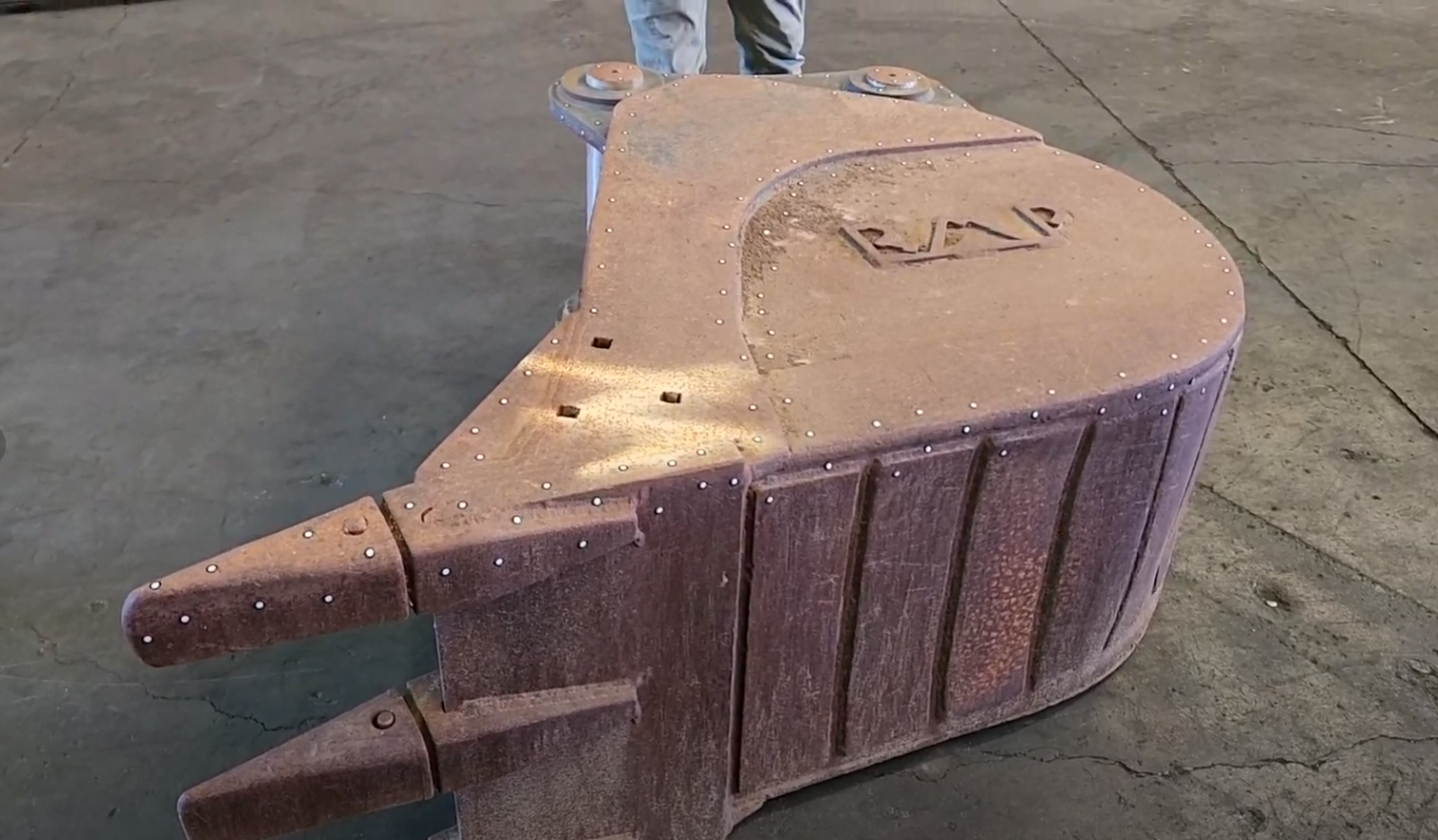
The challenge is clear: excavator buckets are subject to extreme abrasion, deformation, and material loss.
Once wear sets in, it becomes difficult to identify the original shape, cutting edges, and wear surfaces with enough accuracy to restore the bucket to its optimal working condition.
Manual measurement methods often fail to capture complex curves and uneven surfaces, leading to over-welding, misalignment, and shortened service life after repair.
This is where 3D scanning technology changes the game. By capturing the exact geometry of worn excavator buckets with high precision, industrial teams can digitally reconstruct original shapes, guide repair welding, and ensure consistent results.
In this article, we’ll explore how handheld 3D scanners like the FreeScan Combo are transforming excavator bucket restoration, delivering faster turnaround times, higher accuracy, and better long-term durability for heavy machinery.

The Real Cost of Excavator Bucket Wear
Excavator buckets operate in some of the harshest environments imaginable, such as mining, quarrying, construction, and demolition.
Constant contact with rock, soil, and abrasive materials leads to predictable issues:
-
Edge and tooth wear
-
Wall thinning
-
Deformed profiles
-
Cracks and structural fatigue
Over time, even small dimensional changes can significantly reduce digging efficiency, fuel economy, and operator control.
If left unaddressed, worn buckets can damage other machine components or require full replacement, a costly outcome many companies want to avoid.
Restoration is often the smarter option, but only if it’s done accurately. Poorly restored buckets may look functional but fail prematurely because the original geometry wasn’t properly re-established.
Why Traditional Measurement Methods Fall Short
For decades, bucket restoration has depended on manual techniques such as calipers, tape measurements, physical templates, and visual inspection.
While these methods can work on simple shapes, excavator buckets present several challenges:
-
Complex curved surfaces that are difficult to measure consistently
-
Irregular wear patterns that differ from one bucket to another
-
Human error during manual measurement and interpretation
-
Lack of digital reference to compare pre- and post-repair geometry
Even experienced technicians can struggle to recreate original bucket profiles precisely, especially when original CAD data is unavailable.
This is where digital tools, specifically industrial 3D scanning, provide a significant advantage.
How 3D Scanning Transforms Excavator Bucket Restoration
3D scanning enables technicians to capture the exact surface geometry of a worn excavator bucket in digital form.
Using a handheld scanner, millions of data points are recorded in minutes, creating a highly accurate 3D model of the bucket’s current condition.
This digital model becomes the foundation for smarter restoration decisions, allowing teams to:
-
Identify material loss and deformation
-
Compare worn buckets to original or reference models
-
Plan welding and machining operations with precision
-
Verify restoration accuracy after repairs
Rather than relying on estimation, restoration becomes a data-driven process.
The FreeScan Combo Series: Built for Harsh Industrial Environments
One of the most effective tools for this application is the FreeScan Combo+ handheld 3D scanner.
Designed specifically for industrial inspection and reverse engineering, it combines blue laser scanning and structured light technology to handle large, dark, and reflective metal surfaces — exactly what excavator buckets are made of.
Key Features That Matter for Bucket Restoration
-
High accuracy for capturing fine wear details
-
Fast scanning speed to minimize downtime
-
Portability, allowing scanning directly on the shop floor or job site
-
Laser scanning mode, ideal for complex metal geometries
-
Minimal surface preparation, even on worn or dirty components
These capabilities make the FreeScan Combo particularly well-suited for heavy equipment repair environments where speed and reliability are critical.
Step-by-Step: Restoring Excavator Buckets With 3D Scanning
1. Scanning the Worn Bucket
The process begins by scanning the excavator bucket in its worn condition. Using the handheld scanner, technicians capture the entire surface including edges, corners, and high-wear zones without disassembling the component.
Because the FreeScan Combo handles dark and metallic surfaces well, scanning can often be performed with little or no surface treatment.
2. Creating a Digital Reference Model
Once the scan is complete, the data is processed into a detailed 3D mesh. This digital model represents the bucket’s exact current geometry.
If an original bucket model or reference scan is available, it can be overlaid with the worn scan to highlight areas of material loss.
Even without original CAD data, technicians can mirror undamaged sections or use historical scans to reconstruct the intended shape.
3. Guiding Repair and Welding Operations
With the 3D model as a guide, repair teams can precisely determine where material needs to be added.
Weld buildup is no longer guesswork, it’s guided by measurable deviations between the worn bucket and the target geometry.
This approach reduces:
-
Excessive welding
-
Rework time
-
Material waste
-
Structural imbalance
The result is a bucket restored closer to its original performance specifications.
4. Post-Repair Verification
After restoration, the bucket can be scanned again to verify the repair. The post-repair scan is compared with the target model to confirm that dimensions, edges, and profiles meet requirements.
This verification step ensures quality control and provides documented proof of repair accuracy, valuable for internal records or customer assurance.
Key Benefits of 3D Scanning for Excavator Bucket Restoration
1. Faster Turnaround Time
Traditional measurement and repair cycles can take days. 3D scanning dramatically reduces inspection and planning time, allowing restoration work to begin sooner and finish faster.
2. Improved Accuracy and Consistency
Every bucket is restored using the same digital standard, eliminating variability between technicians and shifts.
3. Reduced Material and Labor Costs
By welding only where necessary, shops save on filler material, labor hours, and energy costs.
4. Extended Bucket Lifespan
Restoring accurate geometry reduces uneven stress distribution, helping repaired buckets last longer in demanding environments.
5. Digital Documentation and Traceability
Scans create permanent digital records that can be reused for future repairs, comparisons, or design improvements.
Beyond Buckets: Scaling 3D Scanning Across Heavy Equipment Repair
While excavator buckets are a common use case, the same 3D scanning workflow applies to many heavy equipment components, including:
-
Loader buckets
-
Dozer blades
-
Wear plates
-
Hydraulic components
-
Custom attachments
Once implemented, 3D scanning becomes a scalable tool that improves efficiency across an entire repair operation.
The Future of Heavy Equipment Restoration Is Digital
As construction and mining industries push for higher efficiency and lower operating costs, digital tools like 3D scanning are no longer optional — they’re becoming essential.
The ability to capture real-world wear, translate it into actionable data, and verify results digitally sets modern repair operations apart from traditional ones.
Companies that adopt 3D scanning gain not just better repairs, but a competitive edge built on speed, accuracy, and repeatability.
Final Thoughts
Restoring excavator buckets doesn’t have to rely on experience alone. By integrating industrial 3D scanning, repair teams gain clarity, control, and confidence at every stage of the process.
From initial inspection to final verification, scanners like the FreeScan Combo turn restoration into a precise, repeatable, and cost-effective workflow.
If your operation depends on heavy equipment performance, investing in 3D scanning technology could be one of the smartest upgrades you make.
Ready to Modernize Your Excavator Bucket Restoration Workflow?
Modern excavator bucket restoration requires more than skilled welding, it demands accurate digital data. To implement a reliable 3D scanning–based workflow, repair teams need the right combination of hardware and software to capture wear, rebuild geometry, and guide restoration with confidence.
What You Need to Implement This Workflow
To get started, you’ll need a handheld laser 3D scanner capable of capturing worn, rusted, and reflective metal surfaces with high accuracy. This step is critical for excavator buckets, where abrasion, deformation, and material loss make manual measurement unreliable.
Once scanning is complete, scanner software processes the raw data and generates a high-resolution 3D mesh file. This mesh becomes the digital foundation for inspection, reverse engineering, and repair planning.
From there, 3D graphics and reverse-engineering software is used to extract the specific features needed for restoration, such as cross sections, profiles, reference planes, and target geometry depending on your repair and modeling goals.
Recommended Software for Excavator Bucket Reverse Engineering
Geomagic Design X is a powerful reverse-engineering solution for excavator bucket restoration, especially when accurate geometry reconstruction is required from scan data. It enables users to extract precise cross sections and create both 2D sketches (splines, polylines, circles, slots, reference planes) and fully constrained 3D features such as cylinders, spheres, cones, and parametric surfaces directly from scanned meshes.
Unlike basic inspection tools, Design X bridges scan data and CAD by allowing users to rebuild design-intent–driven models, making it ideal for restoring worn buckets to functional, manufacturable geometry
This workflow is particularly effective for teams working with AutoCAD, SolidWorks, Fusion 360, Creo, or similar CAD platforms, where accurate profiles and parametric features are required to guide welding, machining, and long-term repair standardization.
2. QUICKSURFACE | MESH2SURFACE for SOLIDWORKS
For shops working directly in 3D CAD environments, QUICKSURFACE provides advanced reverse-engineering tools that integrate seamlessly with native CAD platforms such as SolidWorks, Fusion 360, and Creo.
These tools significantly reduce the time required to recreate complex bucket geometries by enabling direct modeling from mesh data. Purpose-built workflows help users rebuild worn components faster and more accurately. Tutorials and guided workflows are available on the product page to support reverse-engineering applications.
Explore the Right Tools for Industrial-Grade Scanning
To fully enable this workflow, selecting the right scanner is essential. The FreeScan Combo Series 3D Scanners are designed specifically for scanning large, worn, and metallic components in demanding industrial environments. Their laser scanning technology, portability, and high accuracy make them ideal for excavator bucket restoration, reverse engineering, and inspection tasks.
Learn more about industrial 3D scanning solutions built for heavy equipment repair, reverse engineering, and quality verification and take the next step toward faster, more accurate, and more repeatable bucket restoration.
Frequently Asked Questions
How can I restore an excavator bucket accurately without original drawings or CAD files?
You can restore an excavator bucket accurately by using industrial 3D scanning to capture its current geometry. Even without original CAD data, technicians can digitally reconstruct the intended shape by mirroring unworn areas, referencing similar buckets, or using historical scans. This eliminates guesswork and ensures the bucket is restored to proper working geometry.
What is the best way to measure wear and material loss on an excavator bucket?
The most reliable way to measure excavator bucket wear is with a handheld 3D scanner. Unlike manual tools, 3D scanning captures the entire surface in high detail, clearly showing material loss, deformation, and uneven wear across cutting edges, side walls, and wear plates.
How does 3D scanning reduce rework during excavator bucket repair?
3D scanning provides precise, digital measurements that guide welding and machining operations. By knowing exactly where and how much material to add, repair teams avoid over-welding, misalignment, and repeated corrections, significantly reducing rework time and labor costs.
Can 3D scanning help extend the service life of restored excavator buckets?
Yes. Restoring the bucket to accurate geometry ensures proper load distribution and digging efficiency. This reduces uneven stress and premature cracking, helping repaired excavator buckets last longer in demanding environments such as mining, quarrying, and construction.
Is handheld 3D scanning accurate enough for heavy equipment repair?
Industrial handheld 3D scanners like the FreeScan Combo Series are designed specifically for heavy equipment applications. They deliver high accuracy on large, worn, and metallic components, making them suitable for precision-driven repair, reverse engineering, and inspection tasks.
How much downtime can 3D scanning save during bucket restoration?
3D scanning drastically shortens inspection and planning stages. What once took hours or days with manual measurements can often be completed in minutes, allowing repair work to start sooner and equipment to return to service faster.
Do I need to clean or coat excavator buckets before 3D scanning?
In most cases, no extensive surface preparation is required. Laser-based 3D scanners are optimized for dark and metallic surfaces, allowing technicians to scan worn excavator buckets directly in the workshop or on-site with minimal preparation.
How do I verify that an excavator bucket was repaired correctly?
After welding or machining, the bucket can be scanned again and digitally compared to the target geometry. This post-repair inspection confirms dimensional accuracy and provides documented proof that the bucket meets performance and quality requirements.
Is investing in 3D scanning equipment worth it for repair shops?
For many repair operations, 3D scanning delivers a strong return on investment by reducing labor hours, material waste, rework, and equipment downtime. The same scanner can also be used across multiple heavy equipment components, increasing overall profitability.
What other heavy equipment repairs can benefit from 3D scanning?
3D scanning is widely used for restoring loader buckets, dozer blades, wear plates, hydraulic components, and custom attachments. Once adopted, it becomes a scalable digital tool that improves accuracy and efficiency across the entire repair workflow.


